
 [show-current-language-name]





What enterprises should really be asking instead
For years, AI translation vendors have led with a familiar claim: “94% accurate.” “98% semantic fidelity.” “Human-level quality.”
These numbers are reassuring. They’re easy to compare in a product brochure or sales presentation. But they’re not the question enterprise buyers actually need answered.
The real question isn’t: “How accurate is this model on average?”
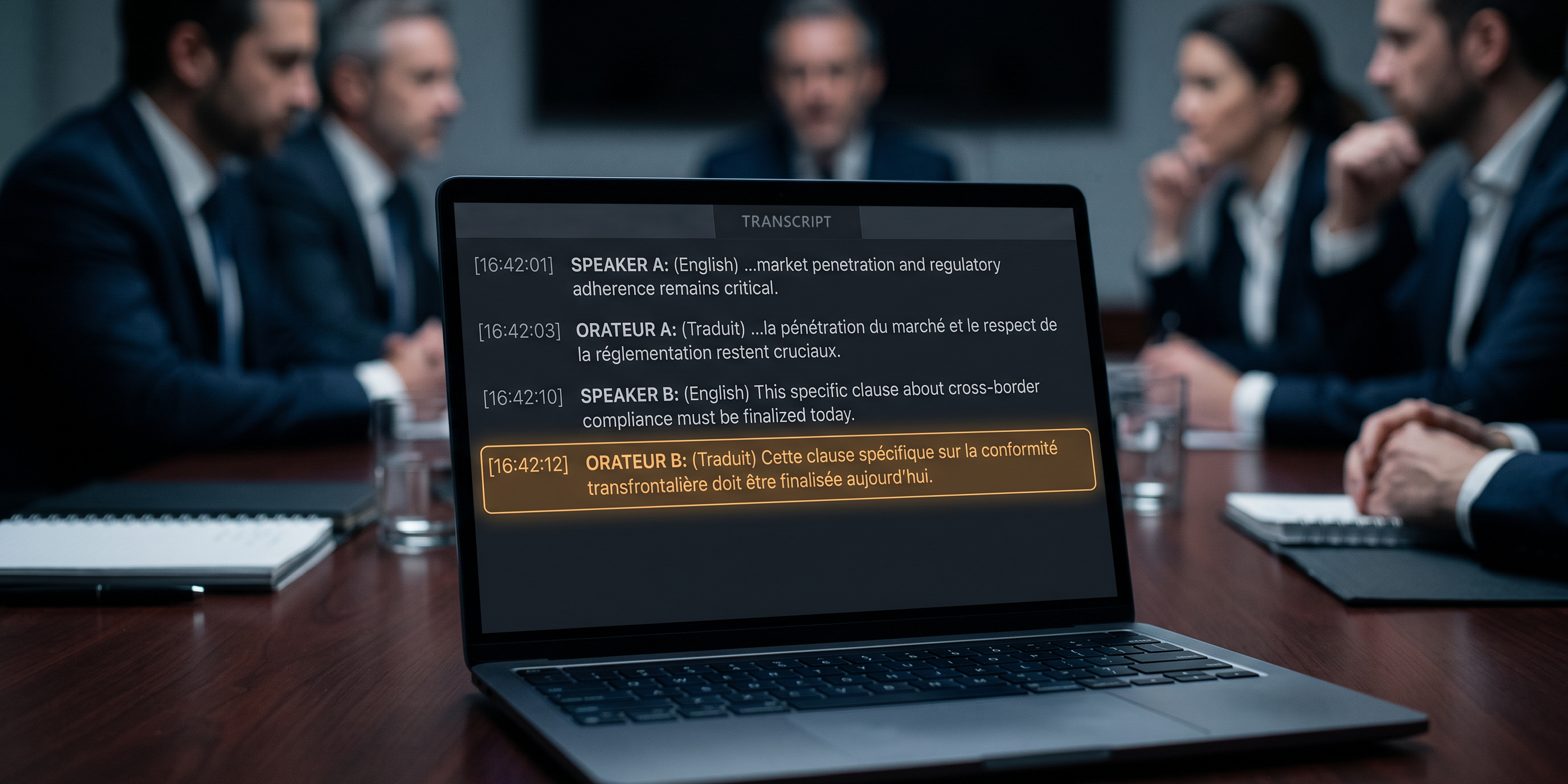
It’s: “In this meeting, with these speakers, discussing this subject, can I trust this specific translation enough to make decisions from it?”
Those are very different questions.
An average accuracy score cannot tell you whether a particular sentence has been translated reliably enough for a board decision, a regulatory discussion, a customer negotiation or a government hearing. And in high-stakes environments, that’s where the hidden cost of “good enough” translation begins.
Accuracy Was Never the Right Metric
Translation quality isn’t constant. It changes depending on language pairs, speaker accents, industry terminology, meeting dynamics and subject matter.
A model might perform exceptionally well translating everyday business conversations between English and Spanish, yet struggle with specialized legal terminology, clinical language or less common language pairs.
A single accuracy percentage averages all of those scenarios together. Unfortunately, that’s precisely the information enterprise buyers need separated.
Increasingly, industry analysts are making the same point: no single AI translation engine performs equally well across every language, domain and use case. Quality is contextual, not universal. The question is no longer whether an AI model is “accurate” — it’s whether it’s reliable for your particular scenario.
That gap isn’t hypothetical. In a 2026 survey of 152 enterprise localization, engineering, and security professionals, 95% already use AI translation in some capacity — yet 20.4% reported more quality incidents or regressions since introducing it.1 Wide adoption and a rising incident rate aren’t contradictory. They’re exactly the pattern you’d expect if headline accuracy numbers were hiding more than they reveal.
Translation Risk Matters More Than Translation Accuracy
One way to think about AI translation is through the lens of risk. Some meetings carry relatively little consequence if an occasional phrase is imperfect.
Examples include:
- Internal team meetings
- Routine project updates
- General company announcements
- Informal collaboration sessions
In these cases, AI translation has matured to the point where it delivers substantial productivity gains with very little downside. Other conversations carry far greater consequences.
These include:
- Board meetings
- Legal proceedings
- Regulatory discussions
- Clinical consultations
- Government hearings
- Investor communications
- Contract negotiations
Here, a single mistranslated sentence isn’t simply an inconvenience. It can become a compliance issue, a contractual misunderstanding, reputational damage or a costly business decision.
The objective isn’t to eliminate every translation error. It’s to understand the level of risk involved and choose technology that’s appropriate for that level of risk.
Trust Requires More Than a High Accuracy Percentage
So what does trustworthy enterprise translation actually look like? Increasingly, organizations are looking for platforms that provide confidence — not just accuracy.
That means combining several capabilities.
1. Confidence scoring at the segment level
Accuracy is retrospective. Confidence is predictive. An accuracy score tells you how a model performed across thousands of historical examples.
Confidence scoring tells you how reliable the system believes this particular sentence is, spoken by this speaker, in this meeting, at this moment.
Rather than presenting one blended score for an entire meeting, enterprise platforms should be able to identify which specific phrases are highly reliable and which deserve additional attention.
That provides something far more useful than marketing statistics — it provides decision support.
2. A clear path to professional human interpretation
There will always be meetings where AI is entirely appropriate. There will also be meetings where organizations decide that the consequences of misunderstanding are simply too great.
In those situations, the question shouldn’t be whether AI can “probably” manage. The question should be whether the organization has immediate access to qualified professional interpreters when required.
Enterprise buyers increasingly want that decision to be deliberate — not left to an AI system making assumptions about when intervention may be necessary.
3. Auditability and governance
Security answers one important question: “Is our data protected?”
Governance answers another: “Can we demonstrate how this translation was produced?”
For regulated industries, organizations increasingly need visibility into what was translated, how it was translated, and which technologies or human professionals were involved.
Being able to demonstrate that process is becoming just as important as the translation itself. It’s also what enterprise buyers say actually earns their trust: when the same 152 professionals were asked what most increases their confidence in an AI translation setup, a full audit trail and reporting ranked among the top factors, cited by 41.4% — well ahead of any claim about model accuracy.
Generic Accuracy Isn’t the Same as Your Accuracy
Even these capabilities assume the AI already understands your organization. In reality, generic AI models know nothing about your products, internal terminology, acronyms or preferred style of communication.
That matters. A translation might be linguistically correct while still being wrong for your business. A product name might be translated when it shouldn’t be. A legal phrase may use terminology your organization never uses. An internal acronym may be expanded incorrectly.
This is why enterprise terminology management has become essential rather than optional. A well-designed glossary allows organizations to teach the system their preferred terminology, product names and brand language before meetings begin.
Without that layer of customization, an advertised accuracy percentage says very little about how well the platform will perform in your environment.
When evaluating vendors, buyers should understand not only whether glossary support exists, but how terminology is created, maintained and governed over time. This isn’t a fringe concern: in the same enterprise survey, 79.6% of respondents named glossary and terminology enforcement a mandatory quality control for production-ready translation — ranked higher than any other safeguard, including human proofreading.
AI Is Ready — Just Not for Every Situation
None of this suggests AI translation isn’t ready for enterprise use. It clearly is.
For multilingual collaboration, internal meetings, training sessions and many customer interactions, AI translation now delivers enormous value while dramatically reducing cost and improving accessibility.
The challenge isn’t whether AI works. The challenge is recognizing where AI alone is appropriate — and where human expertise remains the better choice.
Specialized legal, medical, regulatory and governmental conversations often involve ambiguity, nuanced terminology and significant consequences if meaning is lost.
In those environments, professional interpreters continue to provide value that extends beyond literal translation.
The future is therefore unlikely to be AI versus humans. It’s organizations selecting the right approach for each meeting based on its risk profile.
Building Enterprise Trust
This is the philosophy behind KUDO’s platform.
Rather than assuming one solution fits every conversation, KUDO provides organizations with two purpose-built options: AI speech translation for meetings where automation delivers the greatest value, and professional human interpretation for conversations where precision and human expertise remain essential.
On the AI side, organizations can configure account-level glossaries that reflect their own terminology, products and preferred language, helping improve translation quality before meetings even begin.
The platform is also designed to provide greater transparency into translation performance and governance, allowing organizations to better understand how multilingual communication is being delivered — not simply accept a generic benchmark.
For enterprise, government and international organizations, that’s an important distinction.
The objective isn’t simply translating conversations. It’s giving organizations confidence in the decisions made from those conversations.

Four Questions Every Enterprise Buyer Should Ask
When evaluating AI speech translation platforms, move beyond headline accuracy percentages. Instead, ask:
- Can the platform provide confidence scoring at the sentence or segment level? Can it identify where translations are less certain, rather than treating every output as equally reliable?
- How does the platform support higher-risk meetings? Is there a straightforward path to professional human interpreters when AI alone isn’t appropriate?
- How does it perform in your environment? Can the vendor demonstrate quality across your language pairs, terminology and use cases — not simply publish one overall accuracy figure?
- How is enterprise terminology managed? Can you build, govern and continuously improve organization-specific glossaries over time?
The answers to these questions provide a much clearer picture of enterprise readiness than any single accuracy percentage ever could.
Enterprise Translation Is About Confidence, Not Just Accuracy
As AI translation continues to mature, the conversation is changing.
The question is no longer: “How accurate is your model?”
It’s becoming: “Can we trust this translation enough to act on it?”
That shift — from measuring average accuracy to managing translation confidence and translation risk — will define the next generation of enterprise multilingual communication.
The organizations that succeed won’t simply choose the AI model with the highest benchmark. They’ll choose the platform that gives them the greatest confidence in every conversation.
What the Data Tells Us
Industry trends reinforce this shift:
- 60%+ of enterprises already use AI translation in daily operations
- AI translation adoption is growing at ~25%+ annually
- Human interpretation demand continues to grow steadily
The takeaway? AI is scaling communication, while humans remain essential for meaning and trust.
This is not a translation issue. It is an operational risk.
See it in practice
Want to explore what confidence-based multilingual communication looks like in practice? Book a personalized demo and we’ll show you how KUDO’s AI speech translation, enterprise glossaries and professional interpretation services help organizations choose the right level of multilingual support for every meeting.